David Betteridge visits an arts hub in Clydebank, where he views and reviews a beautiful and disturbing mosaic by Owen McGuigan.
“My subject is War, and the pity of War. The poetry is in the pity.” Wilfred Owen wrote these often quoted words in a preface intended for his one and only collection of poems, a collection that he never saw in print. It was published in 1920, some two years after his death in a volley of machine-gun fire in one of the last attacks made by the British Army against German lines in World War One. This attack, and this death – one of an estimated 18 million deaths occasioned by this “war to end all wars” – happened on 4 November, 1918, at the Sambre Canal, near Ors in northern France, just a week before the Armistice.
Wilfred Owen’s preface also contains a disclaimer that is worth quoting, a corollary to his point about pity: he declares that his poetry is not “about deeds, or lands, nor anything about glory, honour, might, majesty, dominion, or power, except War.”
We need only change the word “poetry” to “art”, and we have the perfect motto-text for a remarkable mosaic recently completed by the Clydebank photographer, video-maker, archivist and artist, Owen McGuigan.
This mosaic is currently (Summer, 2018) on show in Clydebank’s Awestruck Academy, a former snooker hall converted into an arts hub. As well as creating a space where artists can exhibit their work, and exchange ideas with others, the Academy puts on free arts tuition for young people. Its prime mover and guiding spirit is Allan Rutherford, a photographer and musician and local community councillor. In an interview with the Clydebank Post on 26th March, he said: “A lot of artists that come through here have never had the confidence to go to art galleries before. It’s just giving them a wee bit of belief in themselves and the chance to meet other like-minded people.”
Owen McGuigan, hugely experienced himself, is one of these like-minded people helping nurture younger talent. Here he is (below) standing beside his mosaic, which he calls “100 Years”.
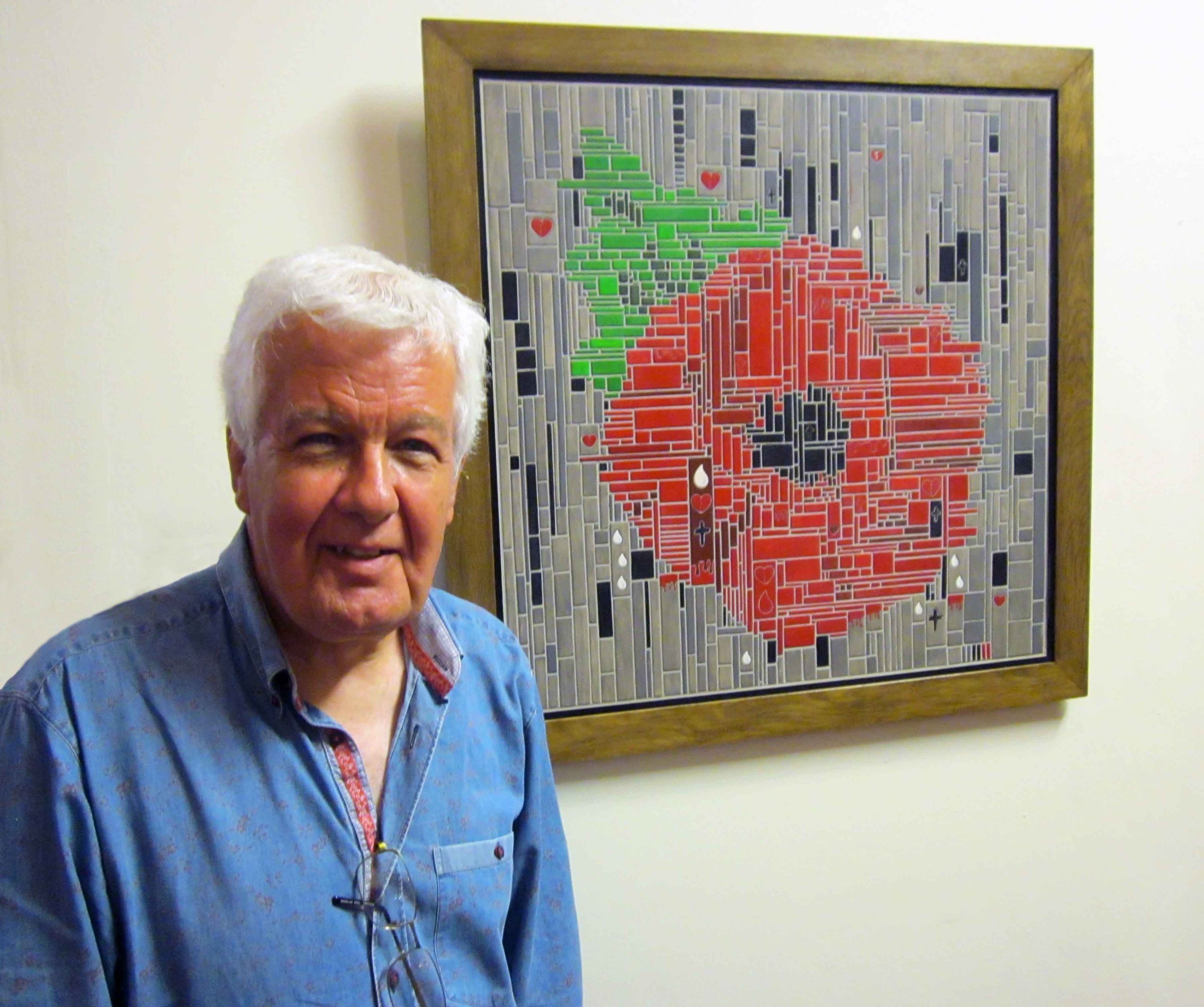
Owen McGuigan standing next to the “100 Years” mosaic
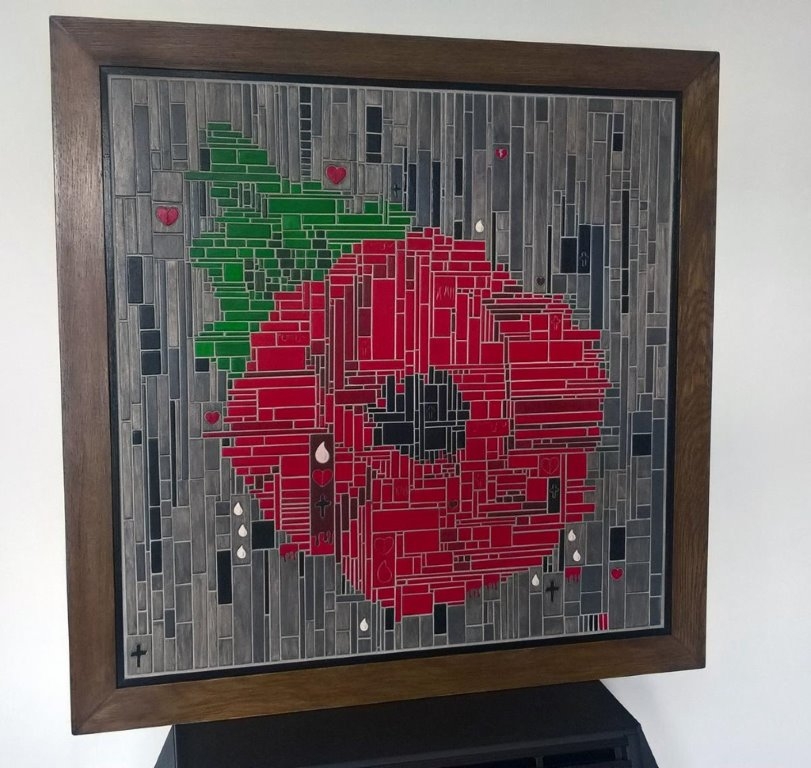
You will see, at first glance, loud and clear, a representation of the Remembrance Day red poppy badge, as made and sold by the British Legion in England. The Scottish version of the poppy has the same red petals, but lacks the English green leaf. Owen chose the green leaf version for his design for reasons of colour variety. You may notice that the leaf’s tip is angled towards the position that would be occupied by 11 o’clock, supposing his mosaic was a clock-face. Directly opposite, just above the bottom part of the surrounding oak frame, in minuscule grey, black and red rectangles, Owen has placed three elevens, reminding us of the exact time and date in 1918 when hostilities were decreed to be over, namely the eleventh hour of the eleventh day of the eleventh month. The more we look, the more we will find similar details of design, both in the poppy itself and in its highly complex grey and black background. All in all, there are 1077 plywood pieces, each one hand cut, then sandpapered, then painted, then stuck in place, then varnished: a labour of love that took several months, on and off.
There is one detail ahead of all the others that may well stand out for you if you let your looking continue for a while. It certainly did for me when I visited the Awestruck Academy, with the artist as my guide. A white tear a bit to the left of the poppy’s black centre quickly made its presence felt, and then drew my attention to three other emblems, arranged vertically below it: there, combining to form a sort of index to the whole mosaic, I noted a heart, a cemetery cross, and a flowing of blood, just as Owen intended.
In time, with more scanning and zooming in, you will locate nine other examples of each of these four emblems, totalling a tear, a heart, a cross and a bleeding for each decade since 1918. From these common elements, Owen has fashioned an uncommonly beautiful work of art, which also carries a heartfelt political meaning.
Remembering his own grandfathers, both of whom served in the trenches and one of whom was killed there, and thinking of the unceasing tally of war casualties staining the world since 1918, Owen felt moved to record and mourn all the blood spilled, the graves filled, the hearts broken, and the tears shed.
Like the bodies of War’s victims, and the lands that are their graveyards, the mosaic is by its very nature fractured, fragmented, and deconstructed. Because of this, and the warning that it gives, it seems closer in spirit to the white poppy symbol, first sold as a lapel badge by the Co-operative Women’s Guild in 1933 and subsequently by the Peace Pledge Union, than to the British Legion’s red poppy. “100 Years” is unequivocally anti-War and pro-Peace.
Owen came to this political and moral standpoint quite early in his life, partly from thinking about his dead grandfather, partly from exposure to images of slaughter and its bulling-up in films. Seeing yet another on-screen victim “bite the dust”, hacked by steel, or plugged by lead, or otherwise slain, he recoiled, he told me, horrified that that victim was someone like himself, someone like everyone, one of Jock Tamson’s bairns.
Reading over what I have written so far, I realise that I have allowed an error to creep in, an error of misrepresentation. Because I was looking at the mosaic as a finished product, I made it sound as if Owen worked on an already mature idea. No, the idea – or plural ideas, rather – that are embedded in the mosaic only came to Owen as he considered how he might use a clutter of plywood off-cuts left over from several previous jobs. The ideas came to him almost of their own accord, entering his consciousness from his well-stocked visual imagination. First the idea of a flower suggested itself; then of a poppy; then of a remembrance poppy; then of a poppy in a landscape blown to grey and black smithereens; then of ten decades of continuing slaughter. As the thought- and work-process went on, Owen had to cut more and more extra pieces especially to fit, complementing the original off-cuts.
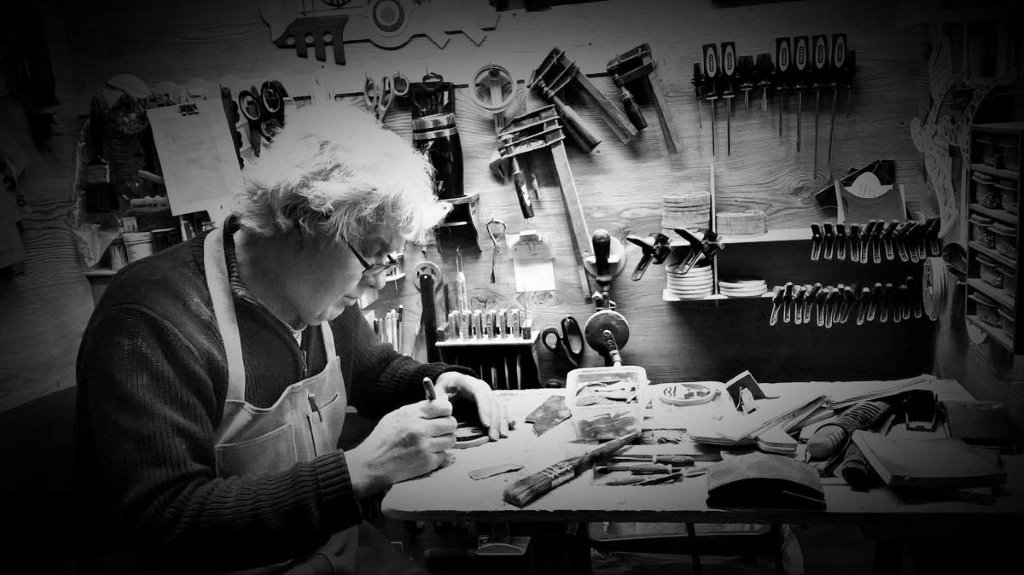
Owen McGuigan at work in his garden shed. “The shed became a small workshop several years ago when my grandchildren started coming along, and I began making Memory Boxes for them, which in turn ignited my love of fretworking again.”
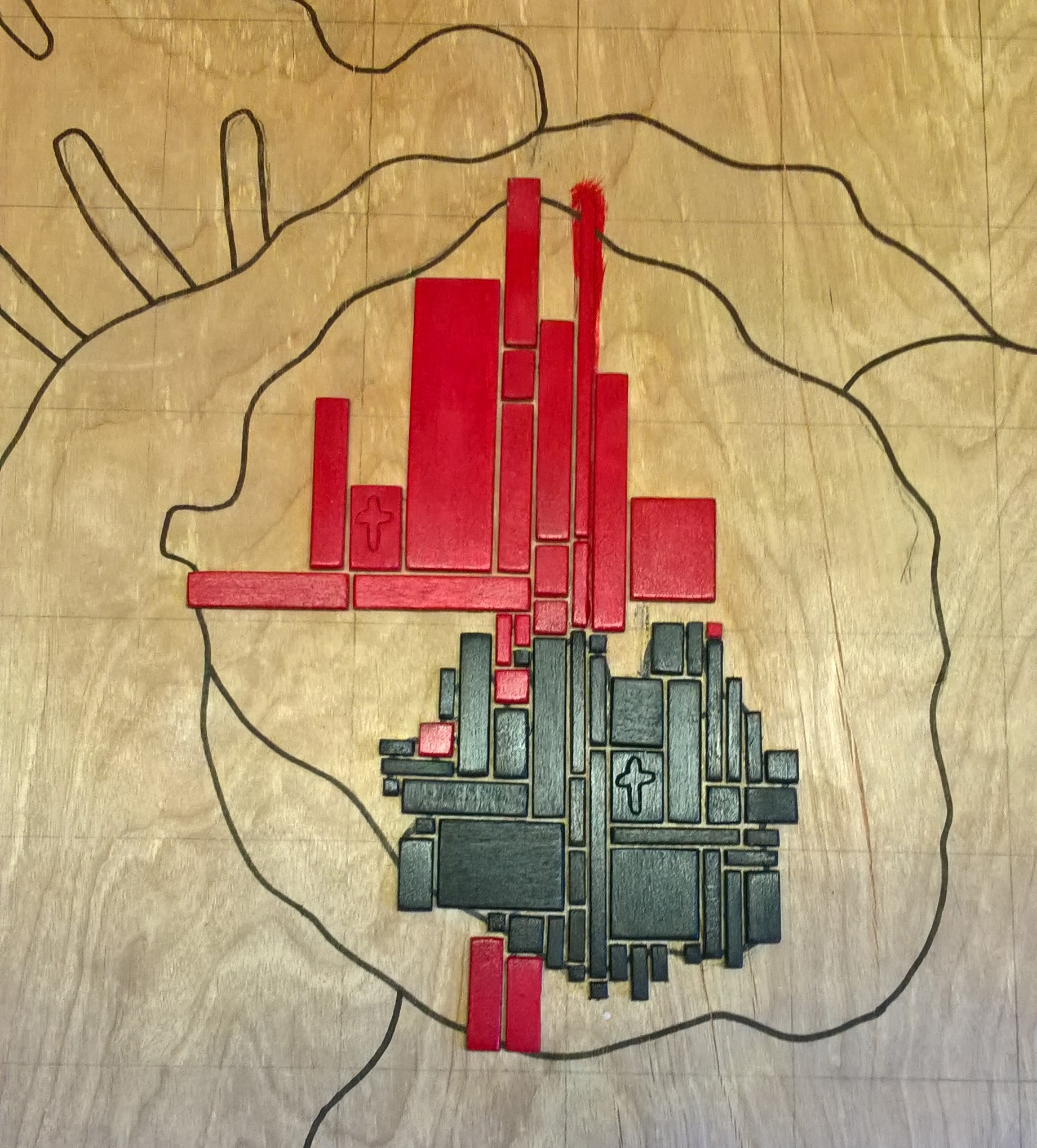
“100 Years”: an early stage in making the mosaic, using a basic outline of a poppy, and developing ideas as it progressed. “I reckon I spent more hours thinking about the piece than it actually took to create, and that in itself was a lot of hours, over several months.”
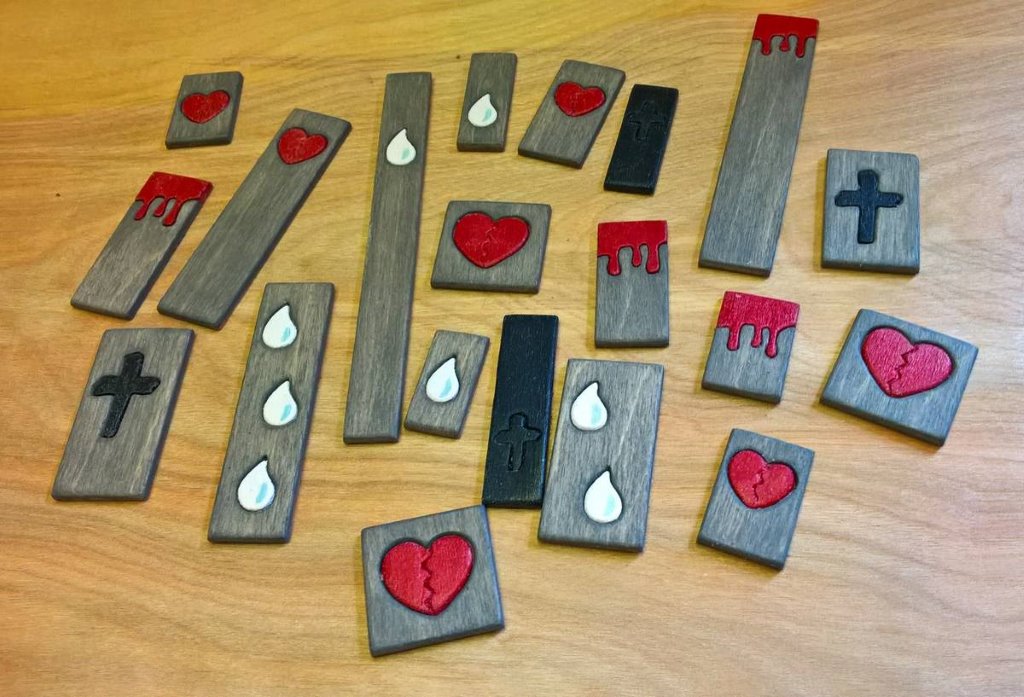
“100 Years”: cutting and painting parts for the mosaic.“As it progressed in my mind, I decided on tears, broken hearts, crosses and blood, and ten of each to represent ten decades.”
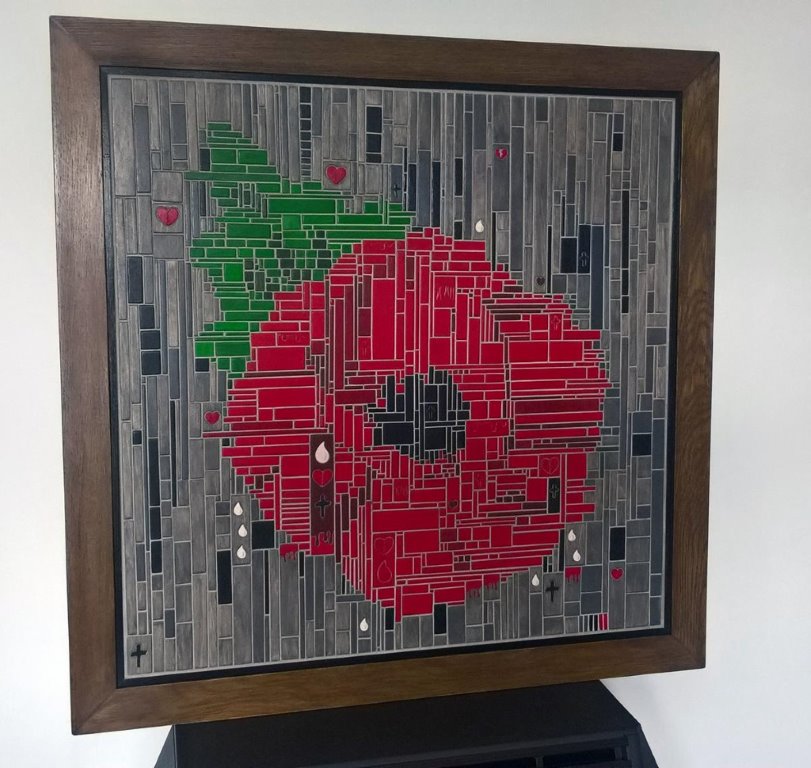
“100 Years”: finished and framed
In this latest work of his, as in earlier ones, Owen shows himself to be a creative soul at the opposite end of humanity’s spectrum from the sort of “dullard” decried by Wilfred Owen in his poem “Insensibility”: the dullard “whom no cannon stuns… mean with paucity… by choice immune to pity and whatever moans in man.” He is alive to, and in tune with his fellow citizens “the world o’er”.
Have a look, for example, at Owen’s video (2010) celebrating shipbuilding on the Clyde, devised as a visual commentary on Leo Coyle’s elegiac “Song o’ the Yard” (see Owen’s “My Clydebank Photos” website, or see “Profit and Loss”, on the “Culture Matters” website); or have a look at his mosaic (2016) capturing the horror of the Clydebank Blitz and the human response to it (see photo below); or have a look at his watercolour and ink picture (2018) called “Melted Rose” (also below), lamenting the recent second fire at the Glasgow School of Art, when so much beauty and usefulness was destroyed; or, if you want cheering up, have a look at his joyous video (2010) showing festivities in Dalmuir Park (see his YouTube called “Dalmuir Park Illuminations”).
You will see in these works listed above, as indeed elsewhere in Owen’s long back-catalogue, the same quality that Geoff Dyer singles out for praise in John Berger’s writings, attentiveness. This quality complements the political, moral and artistic mind-set already described. Attentiveness requires the exercise of all one’s faculties. Dyer makes his point by quoting from a poem, “Thought”, by D.H. Lawrence:
Thought is gazing on to the face of life,
and reading what can be read.
Thought is pondering over experience,
and coming to a conclusion.
Thought is not a trick, or a set of dodges.
Thought is a man in his wholeness wholly attending.
What Dyer says of Berger can be said of Owen, too. See Dyer’s Introduction to Berger’s Understanding a Photograph (Penguin Books, 2013).
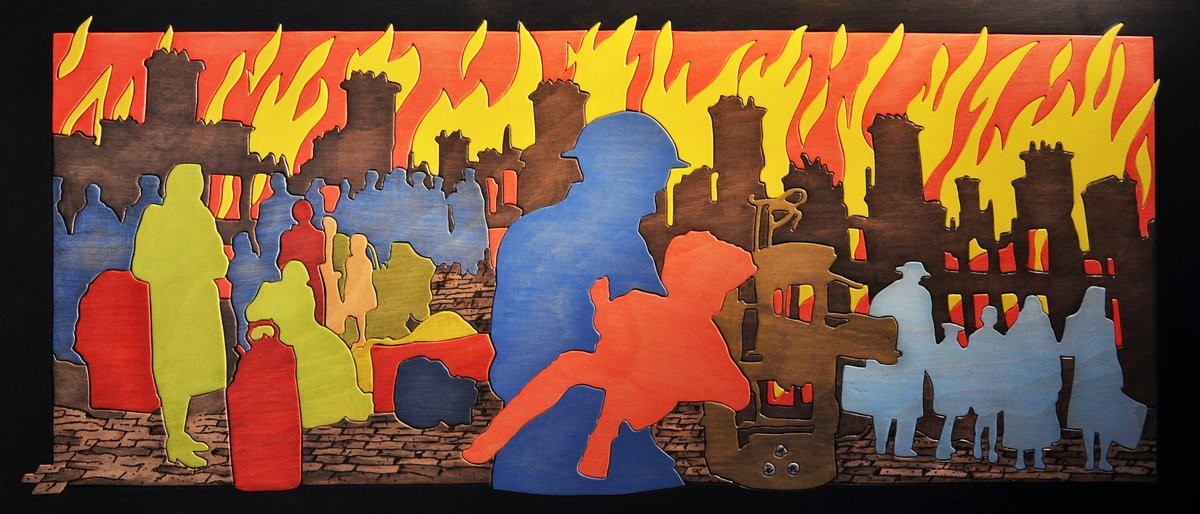
“Blitz Remembered”: fretwork piece (96cm x 41cm) created in 2016 for the 75th Anniversary of the Clydebank Blitz. “I cut the piece from one sheet of plywood. There are 128 individual parts, hand painted with Art Enamels, and several coats of brushing wax to finish it off. It is made up of five iconic images taken from photographs from 1941. My mum and three sisters survived the Blitz.”
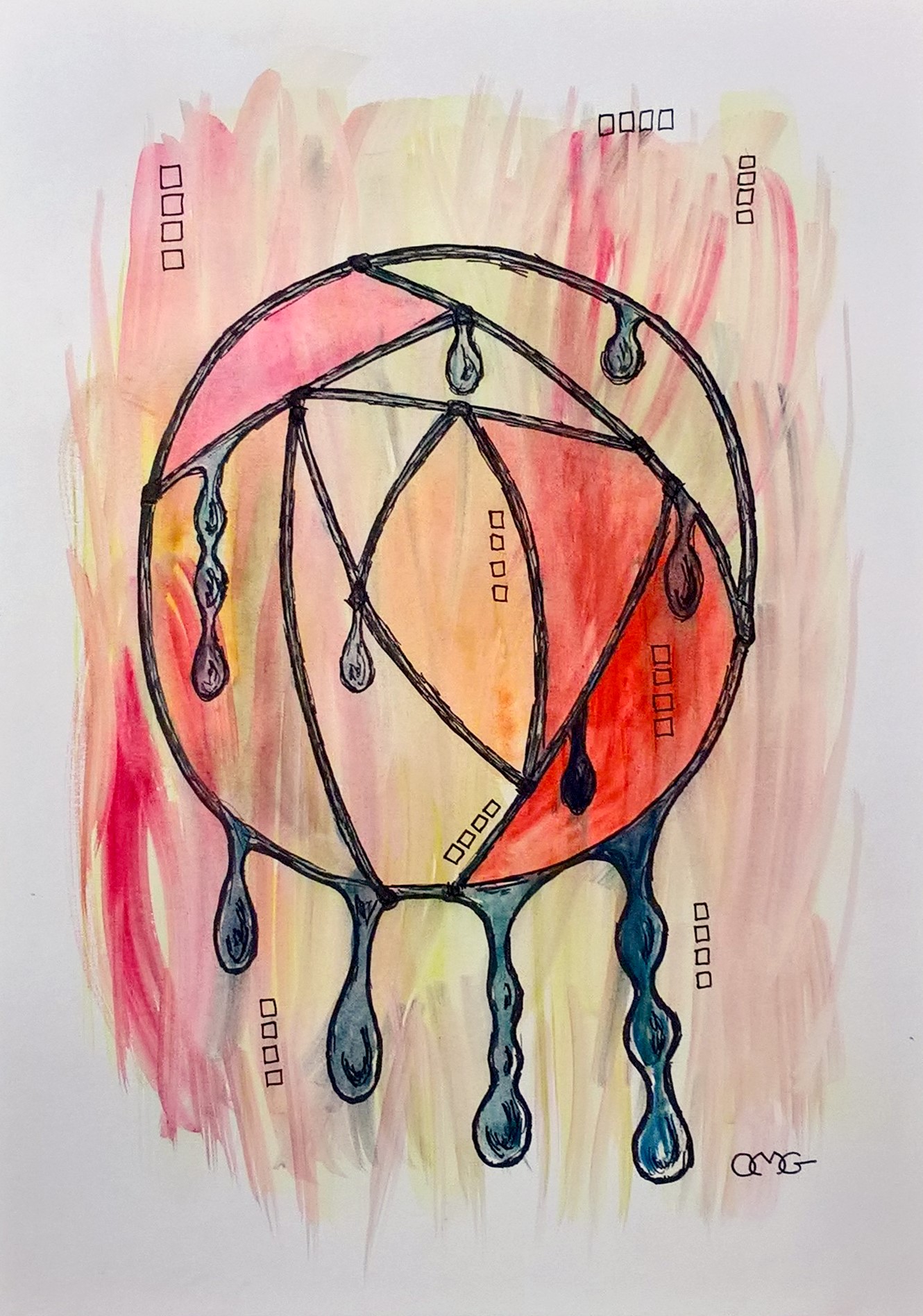
“The Melted Rose”: watercolour and ink painting on cardboard . “I was moved to create this at my local Dalmuir Park Art Class shortly after the second devastating fire of the Glasgow School of Art on 15th June. It depicts the lead melting into tears.”
There is an interesting article in the June/July issue of the Clydesider, where Owen answered a question put to him by the magazine’s editor. “Who or what inspires your work?” she asked. In his answer he gave pride of place to Charles Rennie Macintosh. “I just love everything the man did. It would be a joy to sit down with him and talk shop.” In a virtual sense, Owen has done just that. He has studied CRM’s architecture and designs and paintings with avid attention, interrogating them with his own creative intelligence, starting when Glasgow became European Capital of Culture in 1990. CRM and his works gained widespread international acclaim then, wider than before, notably his Glasgow School of Art, with enhanced local interest as well, including Owen’s.
We can see something of CRM’s inspiration in “100 Years”. It is nothing so obvious as to be termed a style, still less a copying. It is rather a shared passion for combining elements of design that are often regarded as being at odds. There are curvy or “organic” elements in “100 Years” cheek by jowl with geometric ones, especially rectangles, just as there are in CRM’s work; there are mixings of large and small, of bold outline and fine detail, and of vivid colours and duller shades; there are verticals contrasting with horizontals, leading the eye airily up; and there is an overall sense of balance that has nothing to do with strict symmetry, or, come to think of it, any kind of symmetry. As well as CRM’s inspiration, I detect a similar input from his great collaborator, Margaret Macdonald. Her highly wrought backgrounds to such works as “Willowwood” find an echo in “100 Years”.
There is one more source of inspiration that deserves mention, Owen’s father. It was he who introduced his son to handicrafts, notably fretwork, and it is his fretsaw, “older than I am”, that Owen still uses. The magazine that McGuigan Senior began learning from in the 1930s, Hobbies Weekly, acted as a conduit, for both men, for two kinds of skills: practitioner skills, and design skills. The latter included some derived from the gorgeously sinuous pattern-making of the Arts and Crafts Movement.
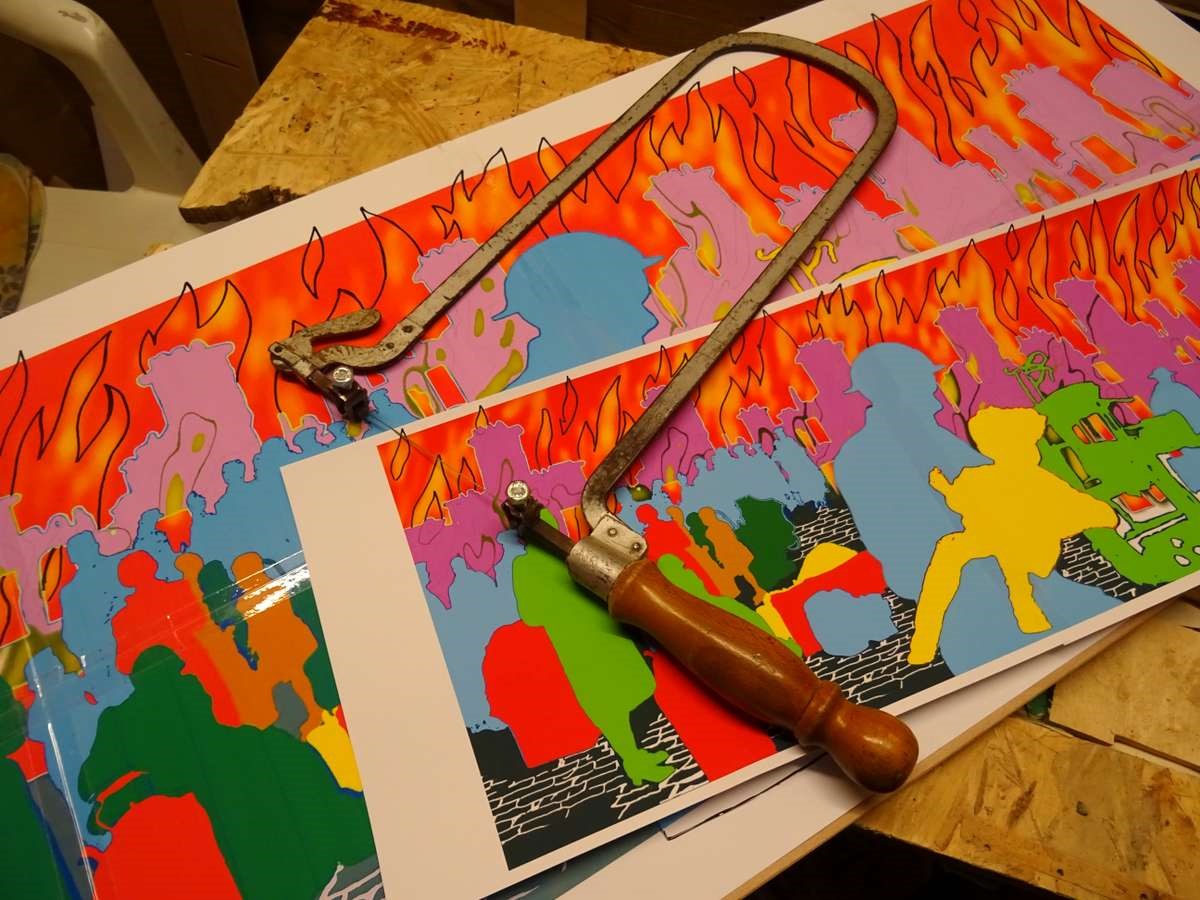
Owen’s dad’s fretsaw,“older than I am. When I was a young boy, my dad showed me the basics of using it. This was over fifty-five years ago. I have had to make some small repairs to the fretsaw over the years. This particular model cannot be purchased now, but fortunately I can still obtain blades for it on the internet.”
I cannot finish this review without mentioning a topic that Owen and I touched on during our conversation at the Awestruck Academy, namely the second fire that devastated the School of Art only four years after a first one had left the building (plus its priceless contents) in need of major reconstruction or replacement. This process was well under way when the hand of fate, or criminal negligence, or something still to be determined, struck. Images of the School’s blackened walls, looming as if from a war-zone over Glasgow’s Sauchiehall Street, have a sad impact analogous to Owen’s “100 Years”, although set in a different context, and on a different scale. Our response is similar: how can we make good this loss, if ever, or at least mitigate it; and how can we guard against other such losses in future?
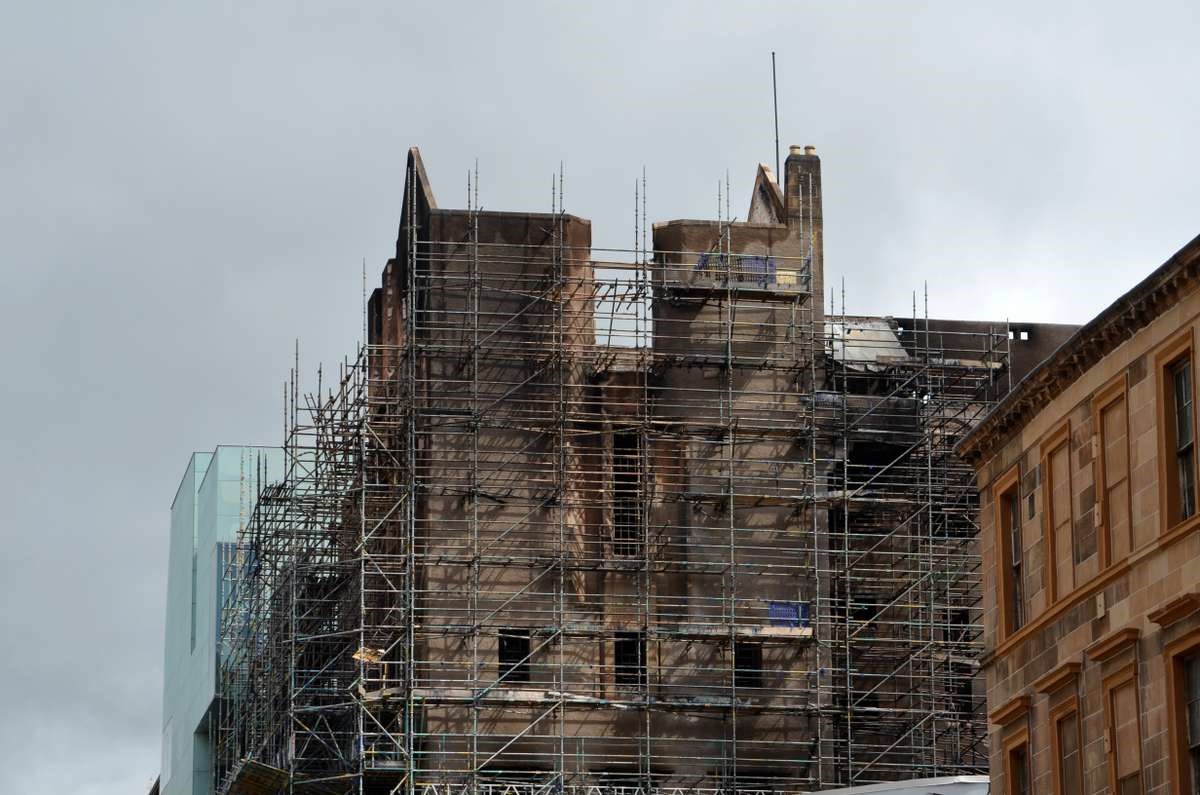
Glasgow School of Art: aftermath of its second fire, June 2018
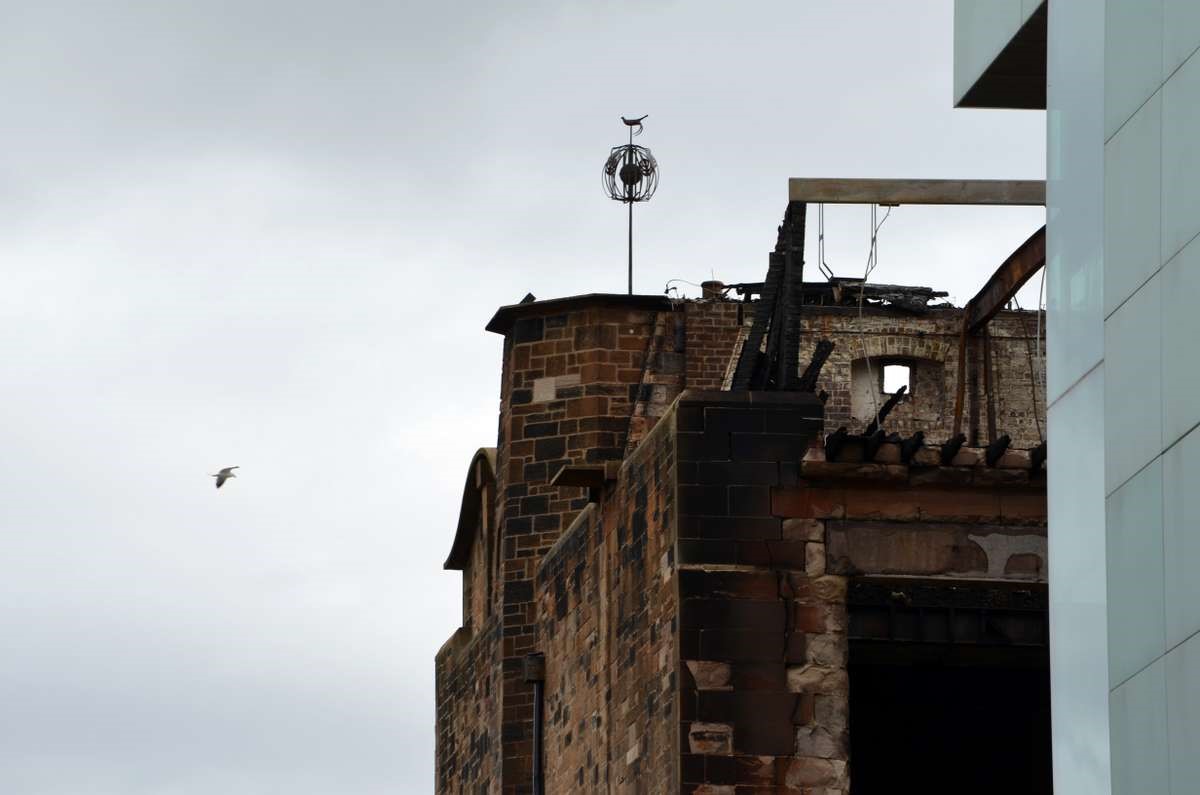
Glasgow School of Art, with its ironwork finial intact
Rennie Mackintosh’s design features a bird flying free above a thicket of foliage. It is derived from Glasgow’s coat-of-arms.
A poem, inspired by Adrienne Rich’s “Natural Resources”, sums up the mood in which Owen and I finished our conversation:
SPIDERLIKE
& building & rebuilding,
over & over where unmaking reigns,
always from love, for love,
how we labour
to remake the ravelled world a home;
& how in anger we relearn,
always & again from scratch,
the need for love
as home & world that we build up
repeatedly are smashed
&&&
“100 Years” is on show for the duration of the summer (2018) at Awestruck Academy, 36 Sylvania Way South, Clydebank, www.awestruck-academy.co.uk