Other/ White Other
by Fran Lock
There is silence in the workshop when the young woman asks me am I sure I’m white. Silence, not embarrassed, but expectant. I do not know what to say. I do not know what to say because I don’t know why she asked. On the surface, the question is too preposterous to parse: of course I’m sure, and of course I’m white. I am obviously white. I am almost flamboyantly white. On a purely physical level, I am the palest thing in the room.
That isn’t what she meant. Or, it is and it isn’t. How to say? There’s the white you are and the white you become. That is, my skin is supposed to be a shorthand, a shortcut, my passport to a shared language of whiteness, where the signifier “white” and the white identity it generates is affirmed and prescribed, where belonging is made and renewed, over and over, through various kinds of “white” performance. I had failed in my performance. If only for a moment, I had missed my cue. I did not correctly speak my symbols. I did not correctly speak my skin. I did not confirm the colour written on my face. She was brought up short, that woman, by something I said or the way that I wrote. In that hot, bright room, under the spotlight of critical scrutiny, the unspoken assumptions that constitute my privilege were being stripped away.
Are you sure you’re white? As opposed to what? By which you mean what? Law-abiding? Educated? Cultured? Moral? By which you mean this shared fund of formal tropes, these icons and these canons, these references, this prosody. If I have betrayed my face, then my text is open insurrection. You turn on me. If you weren’t so educated, if you weren’t so cultured, and if you weren’t so moral, what then? The elite space can’t scream “White Nigger!” and you never would, would you? The work of your whiteness is covert, unconscious even, semi-conscious; invisible, refined, and sly. But you do say “chav”, don’t you? Not to my face, but you say it. And you do say “pikey”. Not British or Irish, but both and neither. To look at I am so white that I disappear daily within your dense crush of Anglophile assumptions. Yet I live within those categories as an alien “other”: strange, estranged inside of whiteness, because you don’t mean me when you say “white”. For you, “pikey” is a way of removing me from the hallowed precincts of whiteness, a form of lexical cleansing.
These thoughts spin through my head as I think of how to answer her. To insist I share their skin is to support the value system that produced the question. But what else should I call myself? Do I not benefit from being pale? Is my whiteness not my subterfuge? My protection? My disguise? My brown and black friends joke that I’m their “sleeper”, that I’m doing deep-cover; I’m their penetration agent inside of academia. But I’m not. I’m a coward, and there are times I’ve used my whiteness like a shield. Subjectively, “pretending to be one of them” feels edgy and subversive. It isn’t. It’s a disavowal of the explicitly “other”. I can “pick my battles”. I can opt-out until I’m found out, until I open my mouth, say the wrong thing in the wrong way, until I give myself away. This isn’t winning. This isn’t turning the tables. This isn’t power. This is a naughty child resorting to cheap tricks because she cannot overthrow the adult order. Her tricks benefit only herself, and not even herself in the long-run.
Class and racial hatred
In the workshop they are staring. And I want to say: well, it depends on what you mean by “white”. And I want to say something, anything else less feeble. I want to howl with frustration. I want to punch her. I want to smash furniture. There’s a template for this question, and I see myself in a thousand shitty political cartoons, where the Irish are apes, alkies and psychos: simian “Biddies” with red faces and beefy arms; swarthy Fenian schemers, cunning tinkers, feckless drunks, machete men, bomb-plotters. Are you sure you’re white? In Irish identity are class and racial hatred muddied and met. To live with this is to be pushed to the point of murderous fury. Furious, but aware that they want your anger, they want it because it confirms them in their low opinion of you. They want your rage, so they can use it as an argument for your continued subjugation, your need to be “civilised”, “occupied”, “taken in hand”. You are feral, in limb and tongue. You are “men that God made mad”. Ireland, what have you done with this, but rolled your shit downhill? Travellers are the Irish it is permissible for even the other Irish to hate. Scapegoats.
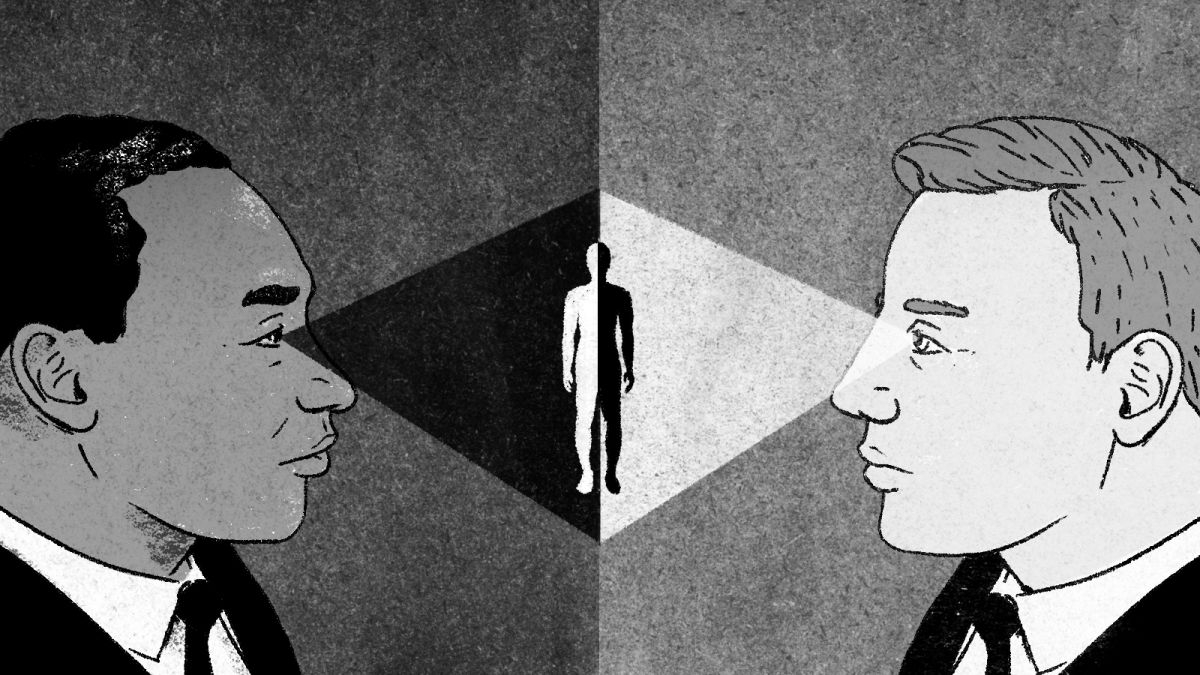
White is not a colour as such, which is why whiteness must define itself in relation to a sea of subaltern “others”; must strenuously perform itself against those others: through the overt violence of the military industrial complex, and the subtle, hidden violence of discourse. This performance is as blunt as petrol through a letterbox, as maddeningly nuanced as the law. Whiteness is continually quantified and measured. This process is so continuous that white people have ceased to notice it at all. What’s that sound? It’s the ambient hum of presumed whiteness, the polite calquing of the implied white audience.
Am I sure? And I think about the myth of “white fragility”. It isn’t merely that white people are seen as being more fragile, but that whiteness itself is a cipher for multiple forms of vulnerability, for a kind of desirable sickness. Whiteness forms on the surface of power like the skin on hot milk. Or, to put it another way, white fragility is money-men in gimp masks turned on by being whipped: it’s a submissive pose, affording us the luxury of surrender without conceding any real advantage. Whiteness is a swooning tyrant in a gilded sickroom. It’s an autocratic invalid. It’s Baby Jane Hudson throwing a tantrum.
And I’m what? Too stroppy? Too robust? Too loud? Certainly I’m not too “healthy”. But my “sickness” is of the wrong order, as likely to lash out as to be self-destructive. How many of these people have ever been arrested? How many of these people have ever been in a fight? How many have ever punched walls or shop-lifted or stole? How many have gone hungry? How many of them have ever been truly angry, flailing and raving and ridiculous with rage? I remember after Thatcher died, and some smug shit on social media talking about how she didn’t hate anyone, and that celebrating someone’s – anyone’s – death was grotesque and inhuman. That’s us, then: grotesque and inhuman. To live without hate is either a luxury or a discipline. A luxury for those with power, and a discipline for those without. She had not been where our communities had been. Or, if she had, she was trying to forget, was acting her amnesia, using her new-found “enlightenment” as a stick to beat us with. She performed her passive sickly-sweet whiteness, beaming it through the screen at us, for likes and likes and likes. Facebook, as the new panopticon of moral correctness, magnified and refracted her whiteness, ’til it glared like the heat at the heart of the sun.
The dead are not poor
They prefer you dead, those people. By which I mean, the dead are not awkward or angry or taking up space. And I was thinking about all those “sensitive” white middle-class students, iPodding Winehouse or Joy Division, making a fetish out of music’s doomed heroes because in their world doom itself is exceptional and exciting, so much so that it confers a kind of status. And being dead, these figures are freed from their difficult contexts, subsumed into a textureless meld with others superficially like themselves, where whiteness alone is the badge of their belonging: their exceptional, sensitive whiteness. The dead are not problematic and hostile and drunk. The dead have no anger management issues. The dead are not a mess of psychosis, addiction and debilitating physical illness. The dead have soulful thoughts expressed in perfect and imperishable grammar. The dead do not hate you. The dead are not poor. The dead may have been all of those things, but now they are dead, they are safe, safer, safest, ready to be packaged, repackaged, re-written, written-over, claimed, reclaimed: discourse. There’s a white middle-class discourse for every working-class subculture you care to name. Mediation, intervention, the spinning of a myth. The white middle-classes create the archive, the archive becomes the crypt.
Am I sure? My head hurts. Because their whiteness will not conceive or recognise another kind of whiteness. How they say “white working classes” in tones of hushed disgust. As if there are no white working classes, or the image is too monstrous to be admitted. “Beyond the pale”. Do you know what The Pale was? It was a strip of land that stretched from Dundalk in Louth to Dalkey in Dublin. During the Late Middle Ages it was in direct control of the English government. A pale is a stake or a fence or a boundary. “Beyond the pale” is beyond the rule of law, beyond ordinary standards of morality or decency. There be dragons, motherfucker, there be Catholics, perverts and savages. The white skin is a border too, its purpose to repel and to contain. And I have transgressed, trespassed beyond the edges of my “colour” into otherness. So am I sure I’m white?
I am not their white, but neither am I the white of their worst nightmares: a council estate “benefit queen”, fertile and feral in equal measure; some uncouth lump in leggings, without rounded vowels or self-control. Child bride in fake tan, and a wedding dress so heavy that it shreds my juvenile hips as I walk. I’m not the stuff of daytime television, their ugly copy-paste poverty porn, but they expect that “underneath”, I am. That I should be. Someone asked me once if my family were like the family in Shameless? Or was my family more like the families in Big Fat Gypsy Weddings? Someone asked me once why I didn’t make more of my “background” to help me secure Arts Council funding. A middle-class publisher rejected my manuscript and questioned my authenticity because – and I quote – “working-class people do not speak that way”.
Yes, I’m white. I am so glaringly white I am practically translucent. There is an irradiated, exorbitant quality to my whiteness: weird and unhealthy in ways that make a mockery of their fair skin. Me and my funny ethnic words. Me and my oddly kiltered meter. Me and my poverty. Me and my lore. Me and my long continuities of violence. Yes, I am sure. And I benefit from the mute assumption that I will sound and think like you. You are not sure. And you need to be sure. And the depth of your anxiety is frightening.