‘We live in capitalism. Its power seems inescapable. So did the divine right of kings. Any human power can be resisted and changed by human beings. Resistance and change often begin in art, and very often in our art, the art of words.’ – Ursula K LeGuin, from her acceptance speech for The National Book Foundation Medal for Distinguished Contribution to American Letters, 2014.
‘Are you a political poet?’ is something I occasionally get asked. My two favourite conversation subjects are politics and poetry (plus religion…perhaps this is why I never get invited to dinner parties!) I am definitely political. And poetical. But am I a political poet?
I never set out to write political poetry. I just write about the things that matter to me, the things that grab me by the heart and twist it, the sorts of things that if I didn’t write them down would bubble around in my head and probably explode. My husband says I am becoming angrier as I get older. He blames it on the Socialism and the Poetry. But it’s not that. It’s just that there’s so much to be angry about right now, I can’t help it. The chaos and mishandling of the Covid pandemic, the massive inequalities in society, a rising acceptance of food banks as the norm, soaring energy bills, job losses, mostly among the working classes, public sector pay freeze and strikes, the aftermath of Brexit and looming spectre of climate change. Trump and Boris. In such a world, how could anyone not be angry?
At times such as this, all forms of art – and poetry in particular – are a way of dealing with and responding to the brokenness of the world. We tell our truths because we have to, because (to quote Martin Luther): ‘here I stand, I can do no other.’
The best political poems convey a kind of truth which is timeless and universal. They go beyond the time in which they were written and reach into ours. They invite us to question universal, fundamental truths: What is our place in the world, and who decided it? Does our society create the realities we strive for, and if not, how can we make things better?
Leon Trotsky writes, in Art and Politics in our Epoch (1938):
‘Generally speaking, art is an expression of man’s need for an harmonious and complete life, that is to say, his need for those major benefits of which a society of classes has deprived him. That is why a protest against reality, either conscious or unconscious, active or passive, optimistic or pessimistic, always forms part of a really creative piece of work. Every new tendency in art has begun with rebellion.’
It is this restlessness – this call to rebellion – which fires us into self-expression. Art, and poetry in particular, is both a response and a challenge to the world we find ourselves living in. It can never be unbiased, because the very act of writing creates our own reality. The very best political poems both challenge the reader and inspire us to new visions.
Whenever I try to define what is meant by political poetry, I keep coming up against this word: Truth. What is meant by truth? Are certain truths universal, or is the very nature of what we understand as ‘truth’ always changing?
Nietzsche, in his 1873 essay Truth and Lying in an Extra-Moral Sense argues that there is no such thing as absolute truth. People create the concepts through which they define what is good or just, and these values are changeable as they adjust to shifting cultural values and belief systems. We create our own ‘truth’ about the world through our use of metaphor, myth, and poetry.
Truth, fact and fiction
We live in what’s often referred to as a ‘Post Truth world’. Post Truth is described in the Cambridge Dictionary as: ‘relating to a situation in which people are more likely to accept an argument based on their emotions and beliefs, rather than one based on facts.’ A classic example is Tony Blair’s justification for the invasion of Iraq despite having found no evidence of weapons of mass destruction: ‘I only know what I believe’.
At a time when politicians routinely lie, change their minds and manipulate data to suit their own agenda, we are rapidly approaching what the writer Hannah Arendt (Lying in Politics, 1972), termed defactualization – a point at which falsehood becomes so commonplace that it is impossible to distinguish fact from fiction:
‘Truth or falsehood—it does not matter which anymore, if your life depends on your acting as though you trusted; truth that can be relied on disappears entirely from public life, and with it the chief stabilizing factor in the ever-changing affairs of men.’
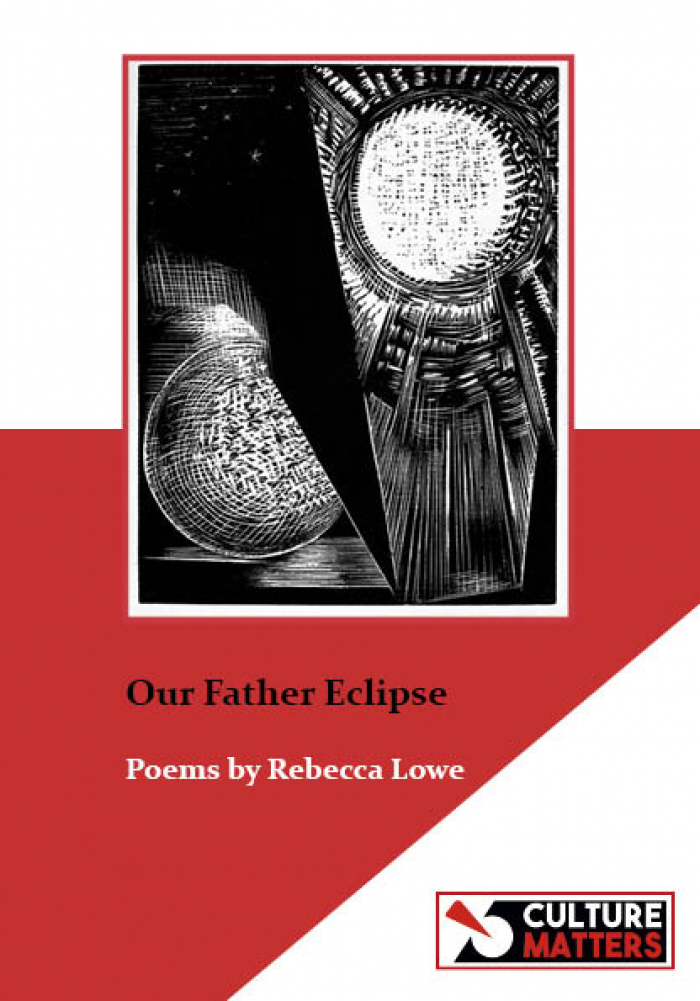
Truth is a recurring theme in my poetry collection, Our Father Eclipse (Culture Matters, April 2021) – the question of who we turn to for answers when all the ‘traditional’ pillars of authority – the State, the Church, scientific impartiality – are no longer trusted. At such times, it can be tempting to switch off the rational part of our brain and seek comfort elsewhere, to try to pretend that the ugliness in the world isn’t really happening:
Let’s put on some music,
Let’s dance to the End of Times, a dystopian waltz,
Let’s sing happy songs, think positive thoughts,
Switch off your mind and live in the Now,
Whilst all around us the world burns,
Whilst all around us, the people die.
The forest is on fire—
You write a poem
Praising the beauty
Of a tree. ‘
– from ‘Beyond Borders’, Our Father Eclipse, by Rebecca Lowe, Culture Matters, 2021
The Russian poet Yevgeny Yinokurov (b.1925) addresses the issue of truths/untruths in his poem Lies:
Telling lies to the young is wrong.
Proving to them that lies are true is wrong.
Telling them that God’s in his heaven
And all’s well with the world is wrong.
The young know what you mean. The young are people,
Tell them the difficulties can’t be counted,
And let them see not only what will be
But see with clarity these present times…
– (p 476, from The Penguin Book of Socialist Verse edited by Alan Bold 1970, publ. Penguin)
Good poets, like good parents don’t sugarcoat the truth. Readers know what the world is really like. Though it might grant us temporary relief sometimes to sink into a poem like a cosy old armchair, the world is not always comfortable or safe. We need to tell these uncomfortable and often painful truths if we are to remain honest. Effective political poetry not only reflects reality in all its harshness but dares to challenge the many truths we have been conditioned to believe. The Italian poet Giovanni Giudici (b.1928) does this very effectively in his poem ‘You Ask Me What It Means’:
You ask me what the word
alienation means:
from birth you start dying
In order to live through a master
who sells you out; start co signing
what you have – power, love, hatred –
so that you may obtain
sex, wine, heart-break
It means that you are beside yourself
but you think that you are
just your own self, because
the wind undermines you, and you yield…
– p.417, from The Penguin Book of Socialist Verse edited by Alan Bold, Penguin 1970)
Radical passion and revolutionary compassion
There comes a time in everyone’s life (doesn’t there?) when you start to question the version of reality that has been fed to you. Perhaps even more so, in this time of growing political and social unrest, where conspiracy theories arise to fill the gaping gulf between our expected future and the grim and frightening reality. At some point, you start to wonder if the dreams you were sold – of a capitalistic world filled with material luxuries which were yours for the taking if you worked hard and didn’t think too much about where they came from or at whose expense – were even worth having. Or where you started to realise that the dreams you were sold were actually nightmares in disguise.
Political poetry, at its best, picks at the seams of the perceived norm, whether it’s war poets challenging the harsh realities of the battlefield against the gung-ho heroic myths they were fed, or women challenging a patriarchally-structured society. Or poets of the Black Lives Matter movement, challenging a world in which people of colour are twice as likely to be stopped and searched, and more likely to be subjected to police brutality.
It’s at times like this when we find our voices – not necessarily because we choose to write political poetry, but because we have to, because we are angry at what we see and heart and pen give us no other option.
In a world where truth is a rare commodity, we need to sing, shout and write. We need to speak up boldly and honestly, with radical passion and revolutionary compassion, challenging social injustice, prejudice and inequality. And yes, if that occasionally makes me a ‘political poet’, then I’ll proudly own that title.