‘You’re lifted, Trotsky—in the fucking van.’
Perfectly timed to chime with the 40th anniversary of the miners’ strike 1984-85, this collaborative poetry pamphlet is powerfully delivered by William Hershaw and accompanied by fine illustrations by prize-winning artist, Les McConnell.
Orgreave in Rotherham, South Yorkshire, was the location used by the government and police to orchestrate a violent confrontation with coalminers and activists while they were legally picketing the coking plant on 18th June 1984. The subsequent ‘Battle of Orgreave’ marked a turning point in the strike where pickets in t-shirts were brutally assaulted by police in in full riot gear, with horses, and dogs. Those arrested later had the charges against them dropped due to evidence being fabricated by the South Yorkshire police – the same police service that altered statements a few years later at the Hillsborough Disaster in 1989.
The Orgreave Stations is a raw poetic journey using the traditional form of the Stations of the Cross, biblical quotations, and symbolic religious imagery. The poems and the images capture the working-class struggle before, during and after the strike, and highlights Orgreave as a pivotal moment.
Hershaw himself is well-placed to explore the subject. Coming from Fife, he belongs to a historic line of colliers who experienced first-hand the social injustices wielded by both mine owners and the state. This enables his poetry to navigate the political and moral impact of the government’s response to the strike in an informed manner.
In the opening poem, Station 1: The Road to Gethsemane Allotments, the poet creates a landscape that reveals what it meant to be working-class at the peak of industrialisation in the UK, and to feel the values of love; family; unity; and that workers should be fighting for better working conditions and pay, not quarrelling with each other.
That need for workers’ solidarity is captured in the image of The Miner (as Jesus) preaching in simple clothes with a twisted rope of partnership for a belt – one of many symbolic drawings perfectly executed by Les McConnell throughout the book:
The greatest sacrifice is that of self!
I know you think I’m daft, just wittering on—
To love is hard without condition, love
Yourself, each other, enemies as well
Some of the most poignant lines of disunity can be found in Station 4: Big Pete – the doubting Miner:
Some comrades have gone home, they need the dosh,
There’s others never joined us from the off.
I read a bishop said the strike is wrong…”
Three times the cock crew in the still of dawn.
and in Station 7: Jesus Takes Up His Cross – Hershaw perfectly captures the cliched but all too common negligent Pit Manager:
Down there the ventilation’s poor, no air,
We’re breathing in lungful’s of choking dust,
It’s far too hot, the explosion risk is high.
The boss looked bored but listened with a sigh.
“It’s safe enough −”
Station 9: The Women – highlights women’s contributions during the strike in a sturdy sonnet:
Daughters and sisters, mothers and wives,
At home, fundraising, on the picket line,
With faith and love, strong women all of them…
And Station 10: Crucifixion – uses the analogy and symbolism of lost miners both in pit accidents and those who cross the picket line:
“We’ll bring them to the surface or we’ll die.”
To find them quick, gasping in airless holes,
To dig them out the shit then bring them home
To light and life and air—a slim hope, yet
In Station 13: Death – the tragic deaths of Joe Green and David Jones hold the government to account:
No need for an inquiry – ‘no-one died’.
One of the most charged poems, superbly executed by Hershaw, is Station 5: Judged by Pilate. This satirical tirade employs some deeply offensive language of the time, but serves to illustrate the relentless provocative nature of right-wing political dogma:
So let the miners die, they’re halfway there,
A generation on, no one will care.
Be sensible – extinction paves the way.
I’ve come to make an offer, in good faith,
You see, I’ve kept a judging eye on you
And been impressed. Join us and have your say.
Instead of helping losers, help yourself.
A change is in the air, can you not tell?
Orgreave will be the point, long overdue,
To reassert our right, our might, the coup.
Too long the liberals have held their sway:
The right to strike, free grants, free meals, free speech,
Free this and that, an Open University!
The hope to have it all in easy reach,
Meanwhile the unions get to call the shots.
They’ve stretched the rope too far—and now it stops.
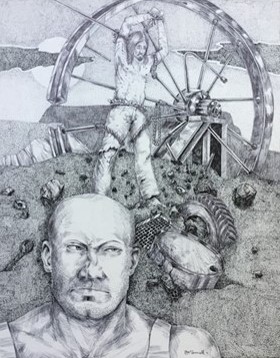
For some, creating the image of the striking miner as Christ might jar, if the crucifixion is interpreted as an act of submission rather than an act of terrible state violence. I am sure ex-miners would not want to be seen as submissively accepting of their fate – they certainly didn’t take the actions of the government, the police and the media lying down. But The Orgreave Stations is boldly illustrating the idea of sacrifice and morality – how a group of ordinary people, often referred to as the ‘backbone of the nation’, stood up to a system that dragged them into a fight most did not want and without any back up plan for change. This aspect is captured perfectly in Hershaw’s Introduction:
‘There were choices to be made, about using the might of the state (the police and judiciary) and the media to maintain a position of wealth and power for the ruling class, or being prepared to make personal sacrifices and take the consequences, for the sake of the community and the working class. The fact that the former won the battle and the latter was not supported by many, made me ask questions then and ever since: how can you be a Christian and a Tory? Can you be a Christian and not a socialist? Who are Christians but mealy-mouthed liberals who sit on the fence while the meek and the weak get bullied and mugged? The wrong moral choices, made at Orgreave, during the Strike, and afterwards, have resulted in the political culture and system we see today—an amoral one totally lacking in empathy and support for working people and their communities.’
The Orgreave Truth and Justice Campaign (OTJC) continues to call for a public inquiry to expose the truth about how the government sanctioned such an appalling act of police violence on a group of people striving to save their jobs and their communities. Full strike documentation is currently not due to be released into the public domain until after 2066, see here.
The Orgreave Stations, Poems by William Hershaw and Images by Les McConnell, £10 plus p. and p., is available here.