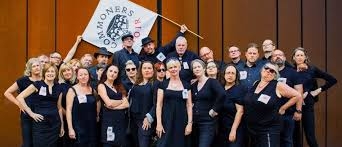
Boff Whalley from the Commoners Choir was interviewed recently in the Morning Star. Here, he describes the background to the choir’s manifesto.
‘Surrealism asserts our complete nonconformism clearly enough so that there can be no question of translating it, at the trial of the real world, as evidence for the defence.’ (From the Surrealist Manifesto, Andre Breton, 1924)
The history of Twentieth Century art is peppered with manifestos. Almost every movement had its manifesto, its declaration of intent. These manifestos were written both to set up guidelines for a new way of making art and to distance a new movement from whatever had come before. A line drawn across the canvas. A rallying-cry. They were all at it: Cubists, Futurists, Dadaists, Surrealists and Pop Artists.
Pop music has mostly shied away from manifestos, with a few notable exceptions. When I say ‘manifesto’ I don’t mean a coke-fuelled egotistic rant. I mean something written down, a legible promise to the world, a thought-out plan. In this category I’d include Dexy’s Midnight Runners and their 1980s full-page ads in the music press taking the place of interviews; I’d include KLF and the regular update of their revolutionary (and surreal) agenda; I’d include anarchist collective Crass and their political proclamations.
These manifestos have always fascinated me, if only because they offer an alternative to the predictable and gradual way that culture changes. Society and culture can have a symbiotic interchange that slowly, slowly, moves the world from one phase to the next, but there’s also a series of forced, provocative changes that jump-start a shift in ideas.
‘History has a stutter… it says, w,w,w,watch out!’ (Mekons, ‘Sympathy For The Mekons’)
I was in my teens when I saw Johnny Rotten, in the Sex Pistols’ first ever televised appearance, spitting out the words “Get off your arse!” before launching into ‘Anarchy In The UK’. That was a three-minute manifesto if ever there was one. Later their manager Malcolm McLaren would make his ten-point manifesto for band management into a film, ‘The Great Rock ‘n’ Roll Swindle’, including such proclamations as “Cultivate hatred. It is your greatest asset.”
Commoners Choir may be the first choir to be built upon a manifesto. It felt right to begin with a declaration of intent, if only because it felt so un-choir-like. The manifesto, now two years old and written before the choir had a single song, began:
THIS WILL BE A CHOIR UNLIKE ANY OTHER.
WE’LL SING ABOUT THE WORLD AROUND US, ABOUT INEQUALITY AND UNFAIRNESS, AND ABOUT THE THINGS THAT NEED CHANGING.
WE’LL SING IN USUAL AND UNUSUAL PLACES; IN CONCERT HALLS, AT FESTIVALS, ON DEMONSTRATIONS, ON MOUNTAINTOPS, AT CABARETS, IN CHURCHES, IN GALLERIES AND MUSEUMS.
Growing up, I began to notice that a vital element of art (and artists) was bravery. Sticking your neck out, doing something that might get you laughed at or ridiculed. Artists who come from working class backgrounds tend not to have the in-built confidence that comes of privilege, it’s harder to open doors and walk into strange situations – there’s always a fear of being picked out and picked on. This makes the bravery all the more important.
A choir can be a show of force. A gathering of enough people to walk into any situation feeling empowered by numbers. The Commoners Choir manifesto declared that ‘we can do this’. I would never have written a manifesto for myself. I’d rather creep in quietly and politely. But it was the manifesto that suggested that we could group together and do something bigger than the sum of our parts. Choirs can make you brave.
‘We intend to sing the love of danger, the habit of energy and fearlessness.’ (First line of the Futurist Manifesto, 1919).
Choirs are nothing if not community. They exist as expressions of communality, of physical bonding, of listening to each other, of playing your part. Of sensing the strength of the whole group, together. Harmonies depend on unity, on empathy.
The Guerilla Girls, a group of activist artists in New York in 1988, would turn up at major art openings in their gorilla masks and cause havoc. They were intent on showing the world that art – in the museums and galleries – was sexist and unequal. They made a manifesto that, instead of declaring intent, pronounced a whole list of sarcastic, tongue-in-cheek demands that beautifully undermined the male-dominated artworld.
More recently, Pussy Riot – imprisoned in Russia for their anti-Putin performance inside a Russian Orthodox church – made an ad-hoc manifesto:
GET OUT OF YOUR BUBBLE
BE MORE RADICAL THAN CORPORATIONS
IDENTITY IS EVERYTHING
LOOK AFTER YOURSELF
NEVER FORGET TO HAVE FUN
Maybe part of this whole ‘manifesto’ business is about making promises to yourself. Making statements that mean you can’t back-slide into some middle-of-the-road version of your original idea. As Andre Breton said in that first Surrealist manifesto, ‘this is evidence for the defence’. Here’s the plan, and if we become something else, then charge us, denounce us.
Commoners Choir is just a choir, when all’s said and done. A bunch of people singing together. But the changing political situation has given us extra impetus to stick to our guns and be that bunch of people who ‘sing about the world around us’. We don’t sing covers, so that’s extra reason to watch what’s going on and react to it. The choir was formed with this manifesto, with these pledges, before Brexit, before Trump. How could we not be even more determined to address worldwide social injustice?
The De Stijl movement, notably featuring painter Piet Mondrian, announced itself in 1918 with a manifesto that began, ‘The old is connected with the individual. The new is connected with the universal.’ Today, when digital technology seems intent on battering us with a non-stop bombardment of screen-based information, many people are gradually returning to grounded, physical, human, communal activities. Rediscovering creative universals – walking, cycling, baking, singing, playing instruments, painting, gardening. People are searching for things that are down-to-earth, authentic experiences. Experiences with other people.
In addition, people are looking for ways to oppose the ugliness of present-day political power. Looking for ways to protest that are more inventive or creative than signing petitions. With Commoners Choir we’ve tried to forge something that grabs at both these ideas – combining the communal experience with an everyday activism.
So the twenty or so people who showed up at the first Commoners Choir rehearsal two years ago discovered only a manifesto and a single song – an uppity four-part harmony that essentially repeats what Johnny Rotten yelled at that ground-breaking TV performance: “Get off your arse!” It’s our call to arms, our colours nailed to the mast. Borrowing from Dadaist Tristan Tzara, with ‘a manifesto … to fly into a rage and sharpen your wings … to sign, shout, swear, to organize…’