“Education is, before everything else, the process of giving to the ordinary members of society its full common meanings, and the skills that will enable them to amend these meanings, in the light of their personal and common experience.”
Raymond Williams, ‘Culture is Ordinary’
Culture is indeed ordinary, it includes most human activities: the arts, religion, sport, science and technology, TV/ radio and other media, the internet, eating and drinking, etc. etc. All of these topics have political dimensions involving struggles and negotiations over meanings and values. On this hub are articles on cultural activities apart from the arts, which are to be found on the arts hub, surprisingly enough.
Chris Guiton explains why it is essential that the labour movement uses a variety of political and cultural educational programmes to make the case for socialism Antonio Gramsci’s... Continue reading
The Voices by Jim Mainland, with images by Peter Long The voices arrived every morning. In fact, I often seemed to wake to their jibber-jabber. They weren’t the... Continue reading
Paul V. Tims looks at the games industry from a socialist perspective It probably won’t surprise my regular readers to learn that I love videogames. What better... Continue reading
Sean Ledwith reviews Game of Thrones The trailers have been scrutinised down to every second of footage. The stars have conducted their interviews in the form of... Continue reading
Sean Ledwith reviews Angels and Demons, by Tony McKenna, a collection of essays on artists, writers and politicians written from a historical materialist perspective. The role of... Continue reading
Deirdre O’Neill and Mike Wayne discuss the decline and colonisation of working-class culture, introduce The Acting Class and call for culture to be at the cutting edge of counter-hegemonic... Continue reading
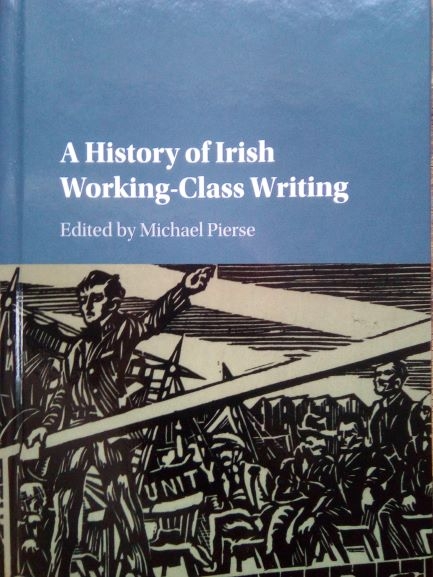
Jenny Farrell reviews a new anthology of working-class writing A History of Irish Working-Class Writing, edited by Michael Pierse (CUP 2017) is a book to be greatly welcomed. It... Continue reading
Jane Rosen writes about revolutionary children’s literature, based on the recent book she co-edited with Kimberley Reynolds and Michael Rosen, Reading and Rebellion: an Anthology of Radical... Continue reading
Jane Rosen introduces ‘Don’t Shoot Your Class!’, by Tom Anderson, first published in The Revolution, June 1918. It is extracted from Reading and Rebellion, an Anthology of... Continue reading
To mark International Women’s Day, Jenny Farrell reviews Pioneers of Women’s Emancipation in Ireland, by Priscilla Metscher Since times immemorial, people involved in the struggle for a... Continue reading